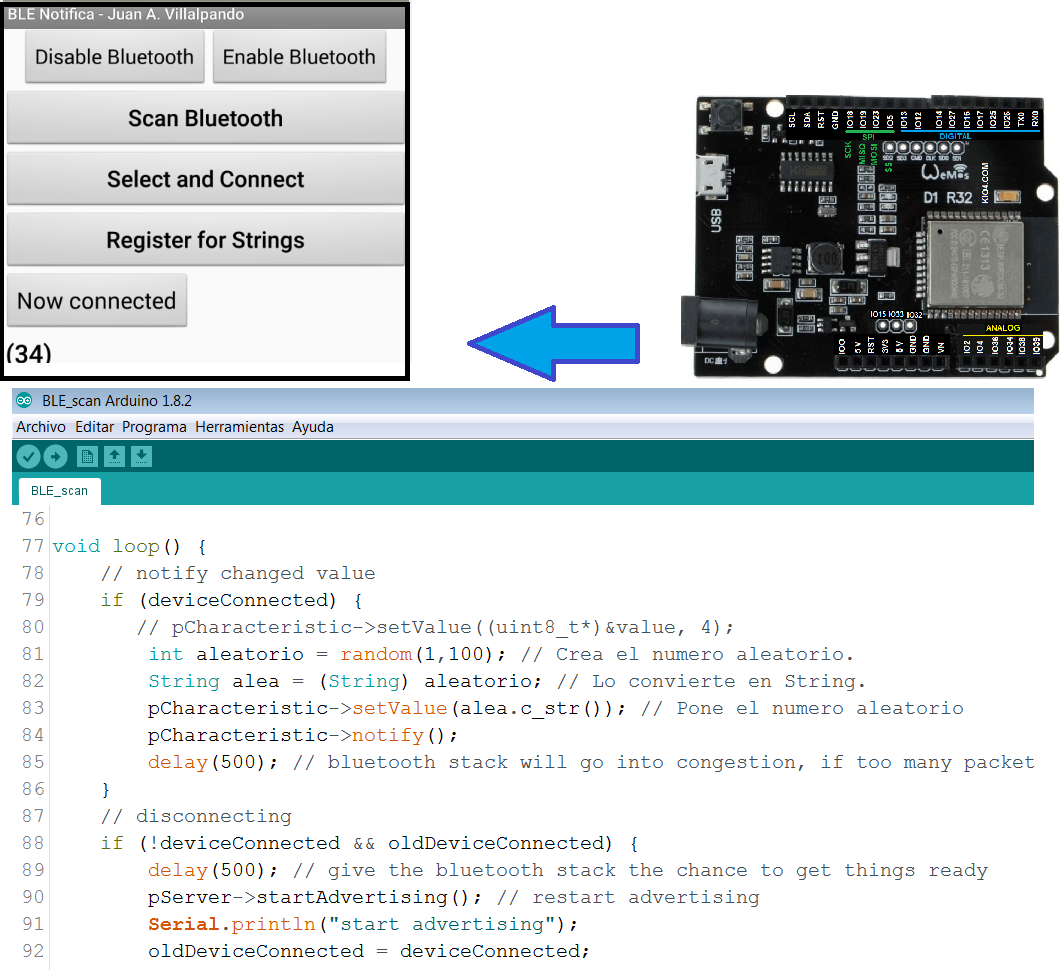
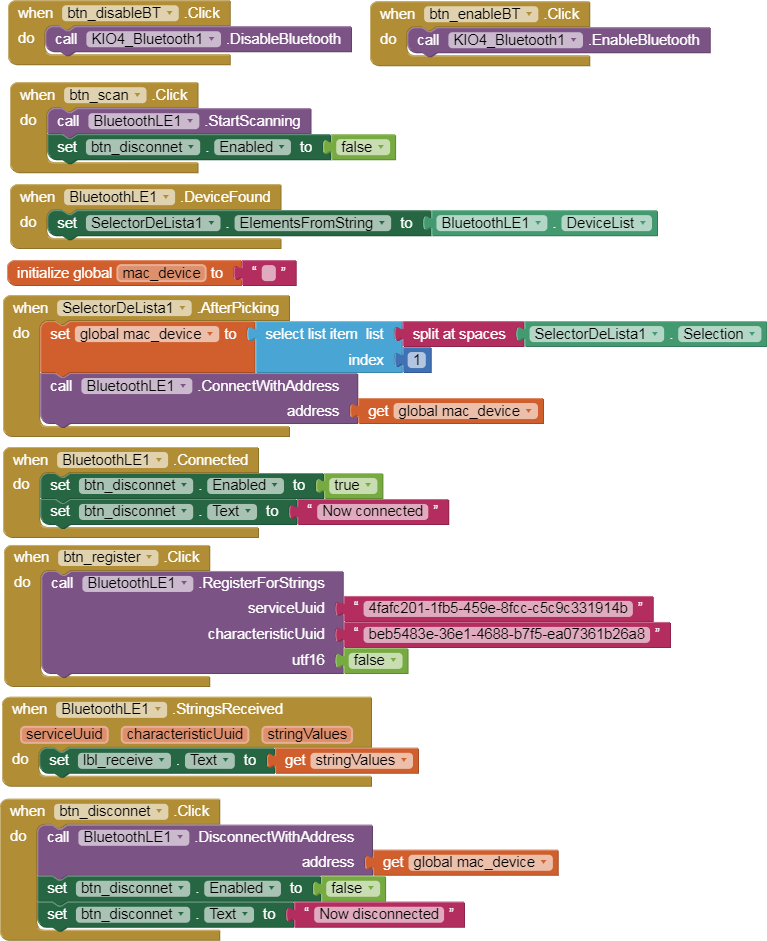
6.- ESP32 sends automatically (Notify) a random number to App.
p110i_esp32_ble_notifica.aia (220.6 KB)
The Bluetooth LE specification includes a mechanism known as notify that lets you know when data's changed. When notify on a characteristic is enabled and the sender writes to it, the new value is automatically sent to the receiver, without the receiver explicitly issuing a read command. (Reference ArduinoBLE)
ESP32 code generates a random number every 500 milisecond and notifies (sends) it to the application.
/*
    Based on Neil Kolban example for IDF:
   https://github.com/nkolban/esp32-snippets/blob/master/cpp_utils/tests/BLE%20Tests/SampleNotify.cpp
   Ported to Arduino ESP32 by Evandro Copercini updated by chegewara
   Create a BLE server that, once we receive a connection, will send periodic notifications.
   A connect hander associated with the server starts a background task that performs notification
   every couple of seconds.
*/

// Modificado por Juan A. Villalpando
// http://kio4.com/arduino/160i_Wemos_ESP32_BLE.htm

#include <BLEDevice.h>
#include <BLEServer.h>
#include <BLEUtils.h>
#include <BLE2902.h>

BLEServer* pServer = NULL;
BLECharacteristic* pCharacteristic = NULL;
bool deviceConnected = false;
bool oldDeviceConnected = false;
uint32_t value = 0;

// See the following for generating UUIDs:
// https://www.uuidgenerator.net/

#define SERVICE_UUID        "4fafc201-1fb5-459e-8fcc-c5c9c331914b"
#define CHARACTERISTIC_UUID "beb5483e-36e1-4688-b7f5-ea07361b26a8"


class MyServerCallbacks: public BLEServerCallbacks {
    void onConnect(BLEServer* pServer) {
      deviceConnected = true;
    };

    void onDisconnect(BLEServer* pServer) {
      deviceConnected = false;
    }
};

void setup() {
  Serial.begin(115200);

  // Create the BLE Device
  BLEDevice::init("MyESP32");

  // Create the BLE Server
  pServer = BLEDevice::createServer();
  pServer->setCallbacks(new MyServerCallbacks());

  // Create the BLE Service
  BLEService *pService = pServer->createService(SERVICE_UUID);

  // Create a BLE Characteristic
  pCharacteristic = pService->createCharacteristic(
                      CHARACTERISTIC_UUID,
                      BLECharacteristic::PROPERTY_READ   |
                      BLECharacteristic::PROPERTY_WRITE  |
                      BLECharacteristic::PROPERTY_NOTIFY |
                      BLECharacteristic::PROPERTY_INDICATE
                    );

  // https://www.bluetooth.com/specifications/gatt/viewer?
  // attributeXmlFile=org.bluetooth.descriptor.gatt.client_characteristic_configuration.xml
  // Create a BLE Descriptor
  pCharacteristic->addDescriptor(new BLE2902());

  // Start the service
  pService->start();

  // Start advertising
  BLEAdvertising *pAdvertising = BLEDevice::getAdvertising();
  pAdvertising->addServiceUUID(SERVICE_UUID);
  pAdvertising->setScanResponse(false);
  pAdvertising->setMinPreferred(0x0);  // set value to 0x00 to not advertise this parameter
  BLEDevice::startAdvertising();
  Serial.println("Waiting a client connection to notify...");
}

void loop() {
    // notify changed value
    if (deviceConnected) {
       // pCharacteristic->setValue((uint8_t*)&value, 4);
        int aleatorio = random(1,100); // Crea el numero aleatorio.
        String alea = (String) aleatorio; // Lo convierte en String.
        pCharacteristic->setValue(alea.c_str()); // Pone el numero aleatorio
        pCharacteristic->notify();
        delay(500); // bluetooth stack will go into congestion, if too many packets are sent.
    }
    // disconnecting
    if (!deviceConnected && oldDeviceConnected) {
        delay(500); // give the bluetooth stack the chance to get things ready
        pServer->startAdvertising(); // restart advertising
        Serial.println("start advertising");
        oldDeviceConnected = deviceConnected;
    }
    // connecting
    if (deviceConnected && !oldDeviceConnected) {
        // do stuff here on connecting
        oldDeviceConnected = deviceConnected;
    }
}