I think it's possible. I've collected some solutions, to some of your problems. Hope it helps 
Click on any of the below subtopics to expand.
Graphing
See these...
- How do I make a graph in MIT App Inventor?
- FAQ Section: Charts and Graphs
- Chartmaker Extension
- ChartMaker Extension - Kager & Manning
- ChartMaker extension decoded - TimAI2
- Donut/Pie/Radar graphs - Alejo Arué Ocampo
- Dynamic graph, sinusoidal wave, shift left graph - Juan Antonio
- Gauge Charts
- Google Sheet Pie Chart Image - TimAI2
- How to generate an animated Pie Chart using the Chart.js library
- Line Graphs using Blocks - Ryan Cheung
- Plotly JS file to display real time data - Giriraj Pawar
- Plotting sin, cos, tan - Scott Ferguson
- Scrolling graph - Martyn_HK
- Scrolling Graph of potentiometer via BlueTooth - kio4.com
- Torus charts using Draw Arc block - TimAI2
- Highcharts Setup on AI2
- Chartmaker Extension - Two Line Charts
Using API
In this chapter, you’ll be introduced to the Web component through a relatively
simple example that accesses fnancial stock price information from a public API
made available by Yahoo Finance. The protocol for talking to this API is fairly simple,
and the data returned is in a list of values separated by commas (comma-separated
values, or CSV), so it serves as a nice introduction to API communication.
Unfortunately, most APIs have complicated permission schemes and APIs, and they
often return data in formats such as JavaScript Object Notation (JSON) or XML, which
require some advanced code to parse.
STOCK MARKET SAMPLE
The figure below shows the blocks for an app that displays Google stock information when
the app launches.
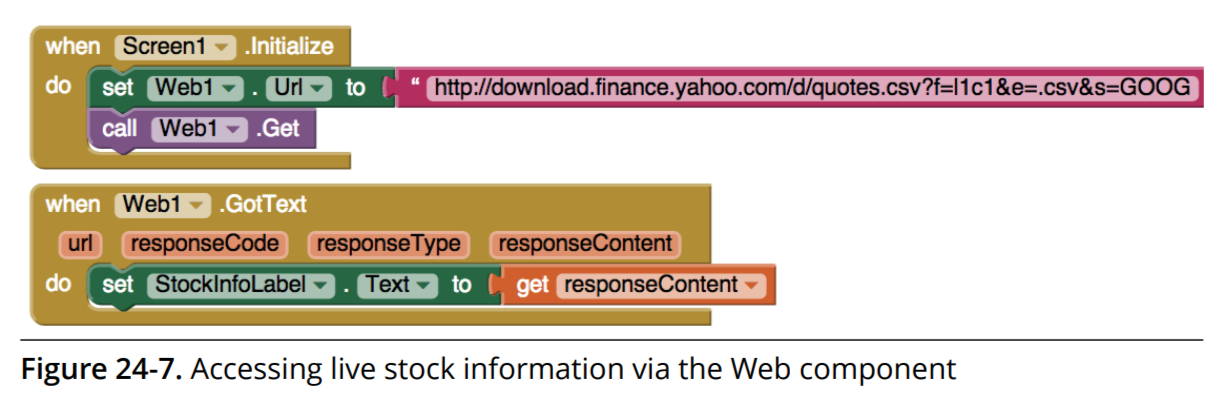
On Screen.Initialize, Web1.Url is set to the URL for communicating with Yahoo
Finance. When Web1.Get is called, the request is made, but no data is returned
immediately.
Instead, when Yahoo returns the requested data to your app, the Web1.GotText
event is triggered, and this is where you can process the returned data. The event
parameter responseContent holds the data. As just mentioned, the Yahoo Finance API
returns data in CSV format. If you build this app and run it, you’ll see that the current Google stock price and the change in the price for the day are displayed in
StockInfoLabel, separated by commas.
You can customize the Web.Url to get the information for a diferent company (or
companies), and to get various types of stock market information. The Yahoo Finance
API, at Google Code Archive - Long-term storage for Google Code Project Hosting., specifes how
you can change the URL to customize your request, as well as the format of the data it
returns.
NOTE: I HAVE COPIED THIS FROM THIS WEBSITE. I DO NOT OWN THIS.