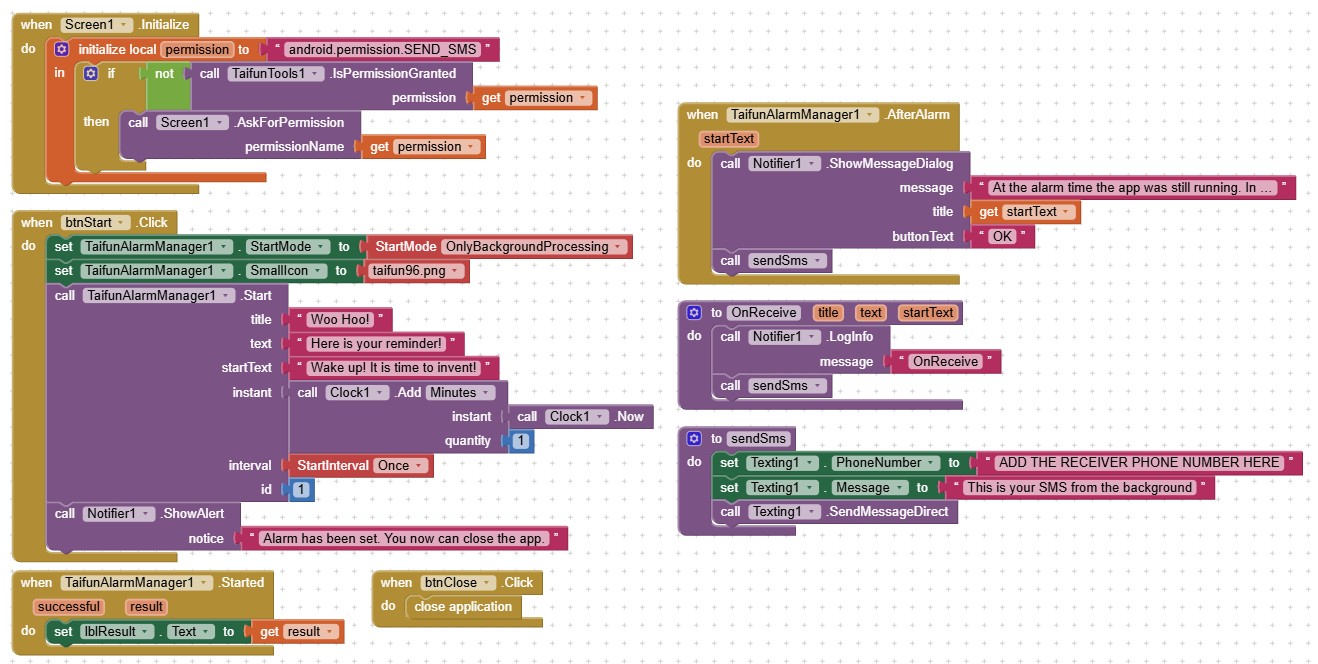
I honestly don't understand how this will help, since the notifications are coming and it's not the problem with them, but with the OnReceive call at 00:10 startnow. The notification that I set for testing doesn't come, which means that the procedure isn't being called for some reason.
How did you set the alarm for 00:10? Remember to do it in an event, for example a button click event
Also use the alarmmanager extension only once, do not drag it twice to the working area
I see you updated your screenshot... the blocks to register the event look better now. Take your time to test. However as GetFarjMinute does not exist before the data has been loaded, you should call it in the event handler after the data has been loaded
If you’re unsure whether the alarm was set correctly, use the Started event to verify it. You can then close the application when the user presses a button.
The startnow notification block triggered with a delay of 7 minutes at 00:17, which is strange... in principle, it doesn't matter to me, the main thing is that it worked, albeit with a delay.
You just found out the difference between inexact and exact alarms
Note : Google recommends to use exact alarms wisely to reduce battery consumption. See also Use cases that might not require exact alarms. If you decide to use exact alarms, then the user needs to grant the SCHEDULE_EXACT_ALARM permission, see method AskForScheduleExactAlarmPermission
Hey! I recently bought @Taifun's Alarmmanager extension to send SMS every 15 minutes even while the devices screen is off. But I can't quite get it to work properly. Anyone of you guys got an idea why?
the texting component has not been designed to send sms in the background...
therefore you will have to start your app at the given time to be able to use the texting component to send the sms
btw. you did not really understand how background processing is working... the AfterAlarm event does not fire in the background, you have to use the OnReceive event handler
AfterAlarm
Event indicating that an alarm occurred. Event will fire only if the app is up and running, else depending on the startMode a notification will be displayed or the app will open screen LockScreen.
I have tested the Alarm Manager extension using the official lockscreen demo app (.aia) provided by Pura Vida.
However, I encountered the following issues:
The alarm only works when scheduled for a short time ahead (around 1–3 hours).
When I schedule alarms for longer periods (for example 16–20 hours later), the alarm does not ring at all.
When I set 3 different alarms for different times about 20 hours ahead, none of them work.
Each alarm uses a different ID.
I have already tried using “Start Always” mode as shown in the demo.
Could you please clarify:
Is there a maximum time limit for how far an alarm can be scheduled?
Or is there a specific configuration required to make long-term alarms work properly?
For your information, I am using a Vivo smartphone with Android 11, and all required app permissions have been enabled according to the demo .aia configuration.
This issue is very important because long-term alarms are currently not working at all.
I now asked Gemini for you. See the recommendations below
Taifun
It sounds like your user is running into the classic "Android Background Execution" wall. Even with battery optimization disabled, Vivo devices (along with Oppo, Xiaomi, and Huawei) are notorious for having aggressive secondary power management layers that the standard Android settings don't always touch.
Since the alarms work in the short term but fail over longer periods, it's highly likely the system is "killing" the app's process or ignoring the AlarmManager to save juice.
Here is a breakdown of what is likely going wrong and how to fix it:
Lock the app in the App Switcher: Open the app, go to the "Recent Apps" screen, and swipe down on the app card to "Lock" it (a small padlock icon will appear).
Check "High Background Power Consumption":
Vivo phones use Funtouch OS, which has its own proprietary battery manager. Disabling "Battery Optimization" in the standard Android settings often isn't enough.
The Fix: The user needs to go to Settings > Battery > High Background Power Consumption and ensure your app is toggled ON. This tells Vivo’s custom skin not to freeze the app when it’s idle for a long time.
Enable Autostart: Essential for any alarm-based app on Chinese OEMs.
On Android 11, Vivo devices require explicit permission for an app to "start" itself (which is what happens when an alarm triggers while the app isn't in the foreground).
The Fix: Ask the user to check Settings > App Manager > Autostart (or search "Autostart" in settings) and grant permission to your app.
Isn't it possible to set two different alarm sounds for two different alarms? Even by automatically changing the sound immediately after a single alarm goes off?
Theoretically it is possible, but to keep it as simple as possible it currently is only possible to set one alarm sound. I probably will consider this feature for future releases
From the documentation
Note : if you want to use a custom notification sound file for your app, you have to set it before using the Start or StartRepeated method. The extension uses only one notification channel to keep the extension as simple as possible. The sound file later can't be changed anymore, because this is set in the notification channel directly.