Yes
Taifun
1 Like
What does the HC-05 send?
I don't see you asking it for text (or bytes or anything) in Screen1.
Upload the HC-05 sketch?
ahhhhhhhh, ok. so i modified the code, in the last post, and it works!!!!! it is a little broken still, apperently the HC-05 thing is constantly sending data or it has something to do with the clock thing. either way, the bluetooth works! the HC-05 blinks slowly when paired. will have to fix the constant push of button issue.
as for ABG, the HC-05 actually sends data when the button is not being pressed,
just found that out by looking at the code, and it doesn't really matter what is being sent as long as it knows that something is getting pressed. i think.
here's my sketch:
void setup() {
  Serial.begin(9600); // Initialize hardware serial for Bluetooth communication
  pinMode(2, INPUT_PULLUP); // Set Pin 2 as input with internal pull-up resistor
}

void loop() {
  if (digitalRead(2) == HIGH) { // Check if the button is pressed (LOW because of pull-up)
    Serial.println("B"); // Send the character 'B' (or any character) followed by a newline
    delay(200); // Debounce delay
  }
}
also, once i press the pedal, it just keeps counting without stopping. i will take a better look later at the code.
so... i forgot to save my sketch, and i got another different one, this:
#include <SoftwareSerial.h>

SoftwareSerial bluetooth(10, 11); // RX, TX (Pins 10 and 11 for Bluetooth)

const int buttonPin = 2;
int buttonState = 0;

void setup() {
  Serial.begin(9600); // For debugging
  bluetooth.begin(9600); // HC-05 default baud rate
  pinMode(buttonPin, INPUT_PULLUP); // Use internal pullup resistor
  bluetooth.println("Arduino Ready");
}

void loop() {
  buttonState = digitalRead(buttonPin);

  // If the button is pressed (HIGH when using INPUT_PULLUP)
  if (buttonState == HIGH) {
    bluetooth.println("1"); // Send '1' (or any char) for button press
    delay(100); // Debounce
  }

  // Optionally, read incoming commands from the app (not needed for sending *to* the app)
  if (bluetooth.available()) {
    char command = bluetooth.read();
    Serial.println(command); // Print to Serial Monitor for debugging
  }
}
(don't worry, I saved it)
also, here is my receiving code,
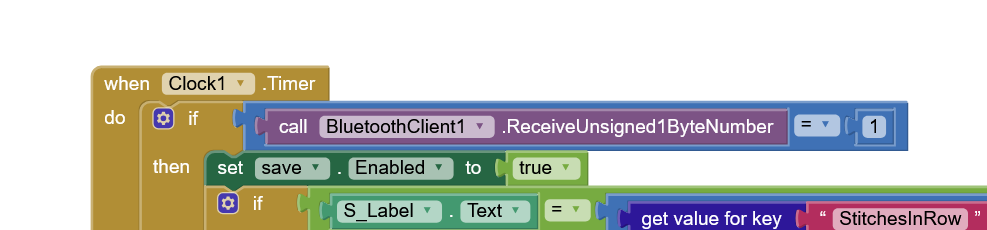
i don't know if that's the right code block, (this is the first time getting into anything bluetooth) but it looked right to me. the code looks fine though, its using the right pin, it sends the right char, the app looks for the right char (or at least that i'm aware of), it looks perfectly fine (but clearly it's not).
i am having trouble using bluetooth, connecting to the hc05 is working, its just that when i press the pedal it doesn't sent number or the app is looking for the wrong thing, OR i'm using the wrong block. any help would be greatly aprieciated. a new problem has wedged itself in with the others,when i run the companian on screen one, it crashes. here is an aia file.
gcc_copy_without_bluetooth.aia (612.9 KB)
On Arduino side you send the string "1" (and not a number), therefore you'd better receive a text with the appropriate blocks on AI2 side.
Please refer to @ABG 's FAQ on the matter, here:
Here is a simple BlueTooth text receiver sample, for single value per line:
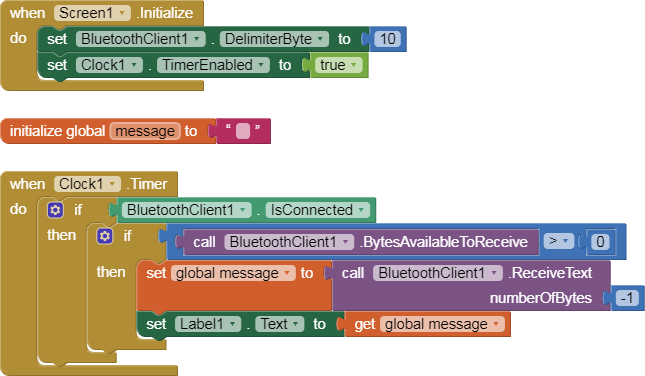

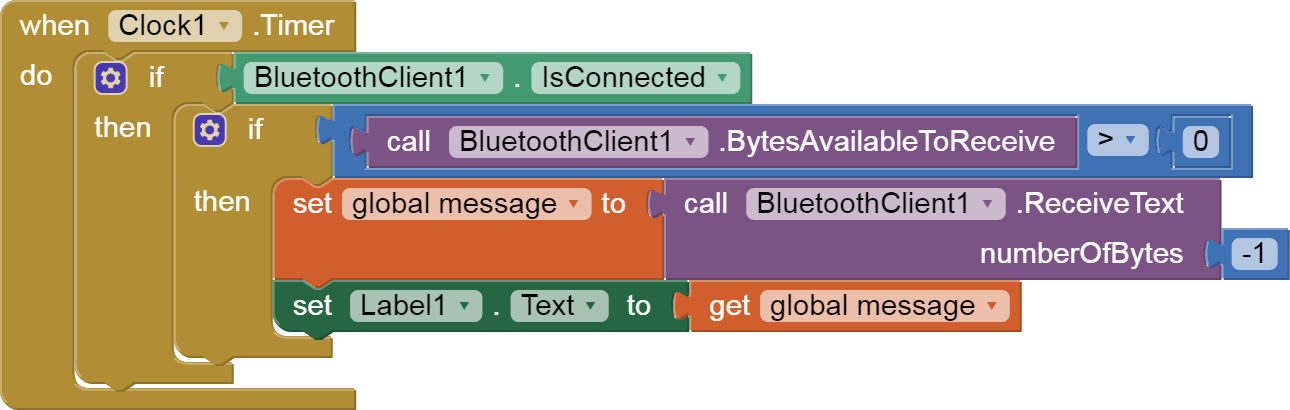
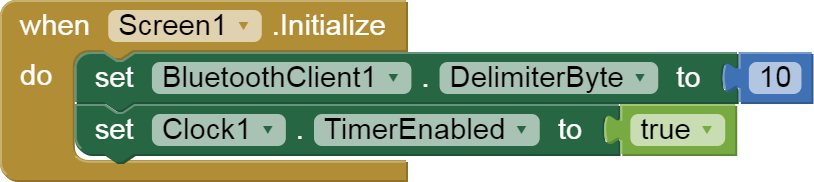
...
I do not advise using a wait extension.
If you need to delay something, save future deadlines computed from Clock1.SystemTime plus whatever delay you need, in mmilliseconds, and check the deadline on following clock timer cycles.
Also, be aware that switching screens breaks Bluetooth connections, so you are better off sticking to a single screen if you use Bluetooth.
You can hide Arrangements to simulate screens.
1 Like
By continuing what @ABG has already suggested about the use of a unique screen, to avoid the BT disconnection when switching between screens, please find attached a sample .aia that shows how to use "virtual screens", made with Vertical or Horizontal Arrangments that are shown or hidden according to the needs.
SmoothFade.aia (1.4 MB) that uses a powerful extension by @shreyash, called Phase that allows to apply "fading effects" when switching beween virtual screens.
Best wishes.

thank you, i will work on the arrangements some time today.
okaaayyy... maybe i didn't work on the arrangements, just a little "busy". but is there any significant drawback to my current setup right now? because when i went to do the arrangements i relized that its a LOT more work than i thought.thank you for all the help.also, the hc05 (probably) sends the signal. i even got the proper recieving thing so i don't think that that the app is the problem. sorry i've been gone so long  .
.
Dear @Hallston, sorry for my late reply, but I was abroad.
I don't know whether you've solved everything, but just to say one thing about the fact that the Arduino code is sending always, even if the button is not pressed: you've set the INPUT_PULLUP condition to read the pushbutton. This is good for electric noise rejection, but this means that the pushbutton shall close to ground (i.e. 0 Vdc) and therefore its active state is LOW, not HIGH. In addition please take care that the delay() function in some Arduino IDE versions, and depending on which board, completely stops the CPU, therefore the serial transmission could be stopped, as well.
To avoid that, typically I use an own made delay like the following:
MyDelay(unsigned long Timeout)
{
unsigned long Now = millis()
while ((millis() - Now) < Timeout) ; // does nothing but leaves the CPU awake
}
// If the button is pressed it goes LOW (the inactive state is HIGH when using INPUT_PULLUP)
if (buttonState == LOW) {
bluetooth.println("1"); // Send '1'when button is tied to low (ground)
MyDelay(100); // Debounce that does not stop the CPU
}
WHAT?!?! when using input pullup the active state is LOW? that makes no sense but come to think of it, when i switched to HIGH it stopped working. but after testing it still acts the way it did before, like nothing did anything. also, you are supposed to connect rx to tx and tx to rx Right? here is the new sketch:
#include <SoftwareSerial.h>
SoftwareSerial bluetooth(10, 11); // RX, TX (Pins 10 and 11 for Bluetooth)
const int buttonPin = 2;
int buttonState = 0;
void setup() {
Serial.begin(9600); // For debugging
bluetooth.begin(9600); // HC-05 default baud rate
pinMode(buttonPin, INPUT_PULLUP); // Use internal pullup resistor
bluetooth.println("Arduino Ready");
}
void loop() {
buttonState = digitalRead(buttonPin);
// If the button is pressed (HIGH when using INPUT_PULLUP)
if (buttonState == LOW) {
bluetooth.println("1"); // Send '1' (or any char) for button pre*
}
// Optionally, read incoming commands from the app (not needed for sending to the app)
if (bluetooth.available()) {
char command = bluetooth.read();
Serial.println(command); // Print to Serial Monitor for debugging
}
}
and here's my other code.
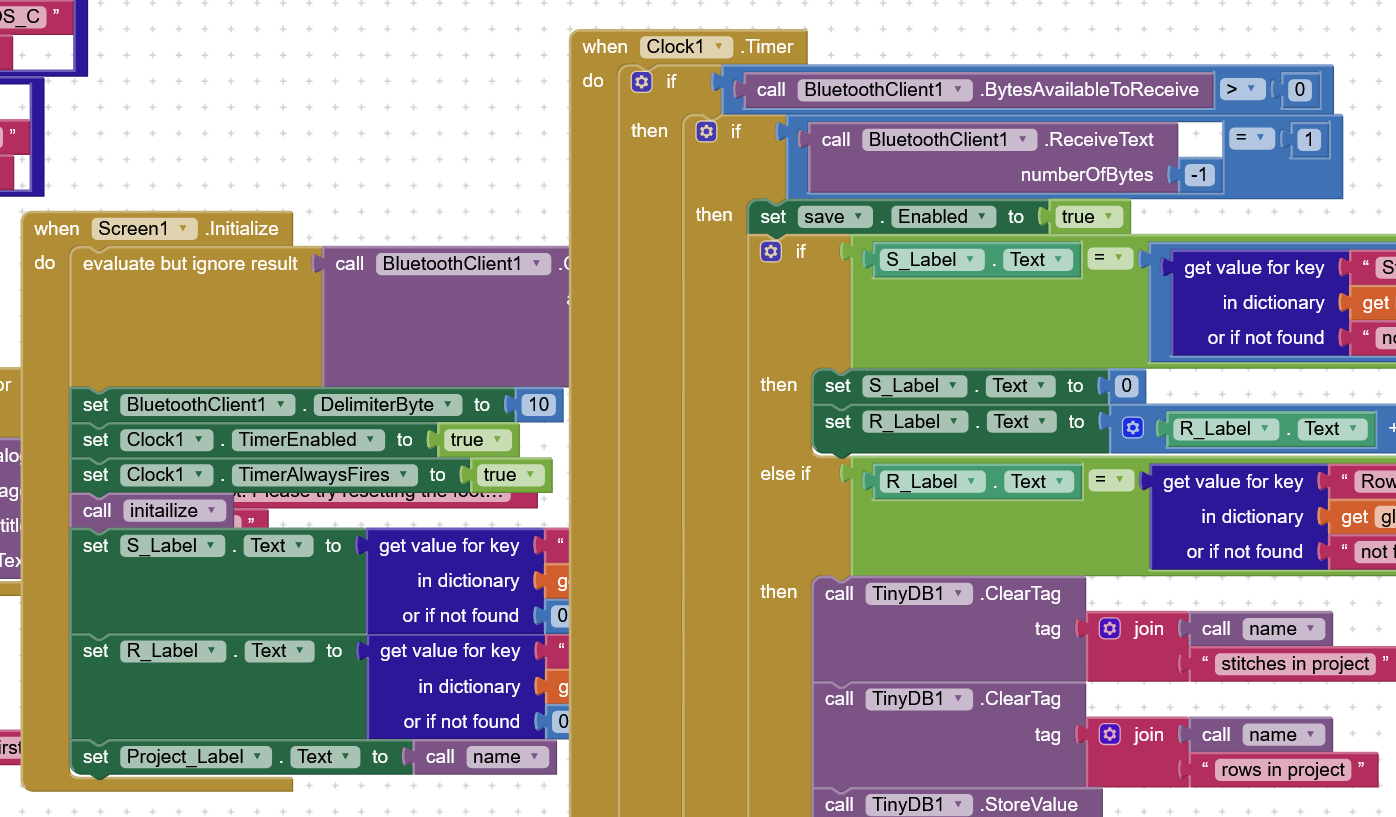
that's right, isn't it?
Dear @Hallston, the INPUT_PULLUP mode uses an internal resistor to make the input steady to the logic ONE. Therefore the external pushbutton shall close to GND to become active like here below
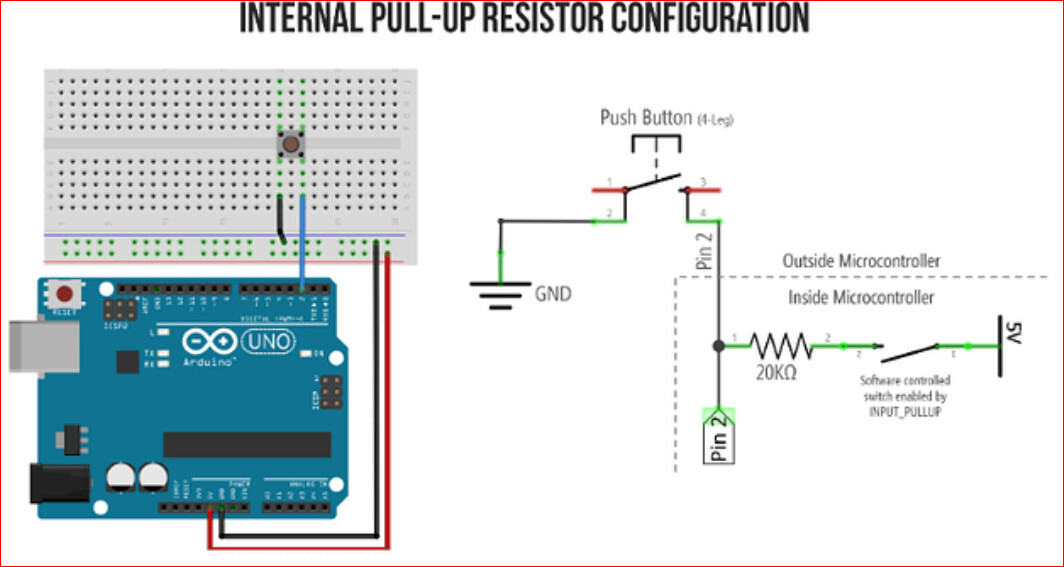
About your Arduino code:
bluetooth.println("Arduino Ready"); this means that at the beginning you send this message to the app.
Please consider that the app could be not ready yet, therefore this message will be lost (not so important, but it could happen).
I see that you are using my suggested code, as far as the input button reading is concerned, but is your HW as the design above ? More over I see that you have discarded competely the delay().
Please be aware that you can still use a "delay", provided that you make your own, as per my previous post.
In your app the use of the read text is wrong: it doesn't provide a boolean, but the received string:
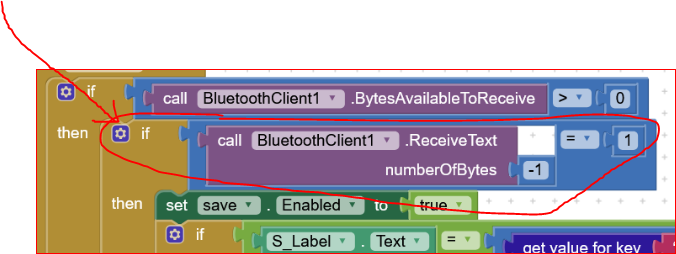
So you'd better modify in a similar way
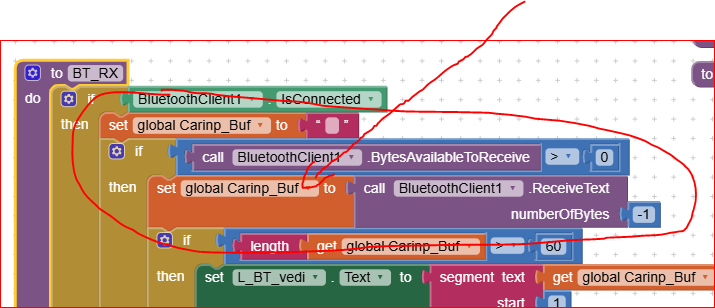
Hoping it helps 
uh huh, so then should i do this?
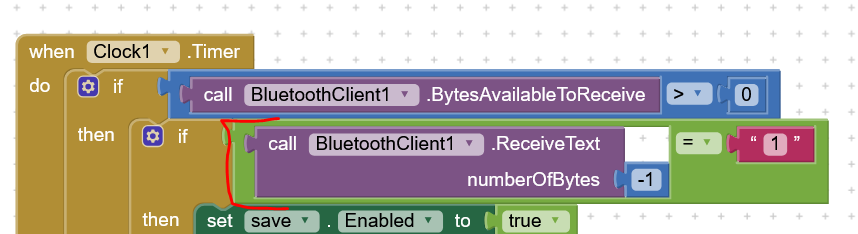
cuz i thought that that (is that even allowed in grammar?) does the same thing.
Dear @Hallston, I'm not that expert about the grammar because I'm not a native English speaker either (and I don't use the translator), but I get what you mean. 
In theory, your blocks might be correct, but since the incoming message usually ends with the character pair 0x0D 0x0A,decimal 13 and 10, which are Carriage Return and Linefeed, your equality check will most likely fail (sometimes just 0x0A, but even then the equality check is fooled).
The best solution might then be to store the incoming buffer into a temporary variable (as I've shown in my previous post) and then check if it "contains" the string/character you're looking for,.something like:
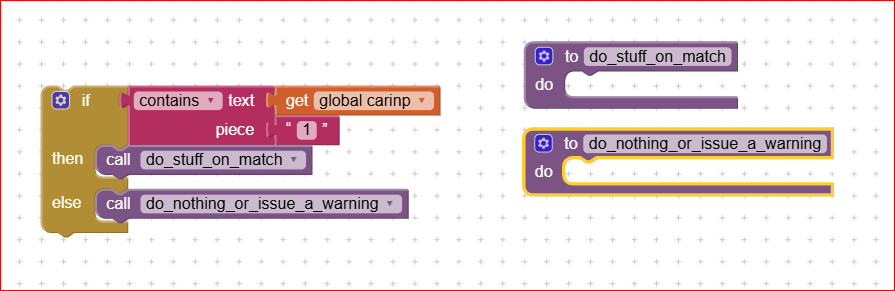
But, what about your Arduino circuitry ? Have you solved it ? Is it transmitting correctly ?
Best of luck !
yeah i think that the arduino is transmitting properly but if it sends extra stuff then this SHOULD work, but it doesn't. this is the new code, can you do this, or do you have to set a variable like you did?
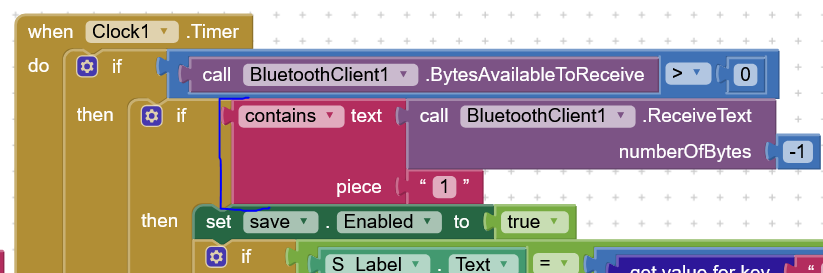
You would have to drop the incoming data into a variable if you don't want to immediately lose it after the contains block reports its results.
So if you wanted to save the incoming data for a log or for a total or for checking other input values, you would definitely need to capture it into a variable.
Variables are the dinnerware for data.
Don't visit the buffet without a plate.
1 Like
ok, so i don't want to save, so i don't need a variable? also it doesn't work, which is confusing. any help would be greatly appreiciated.
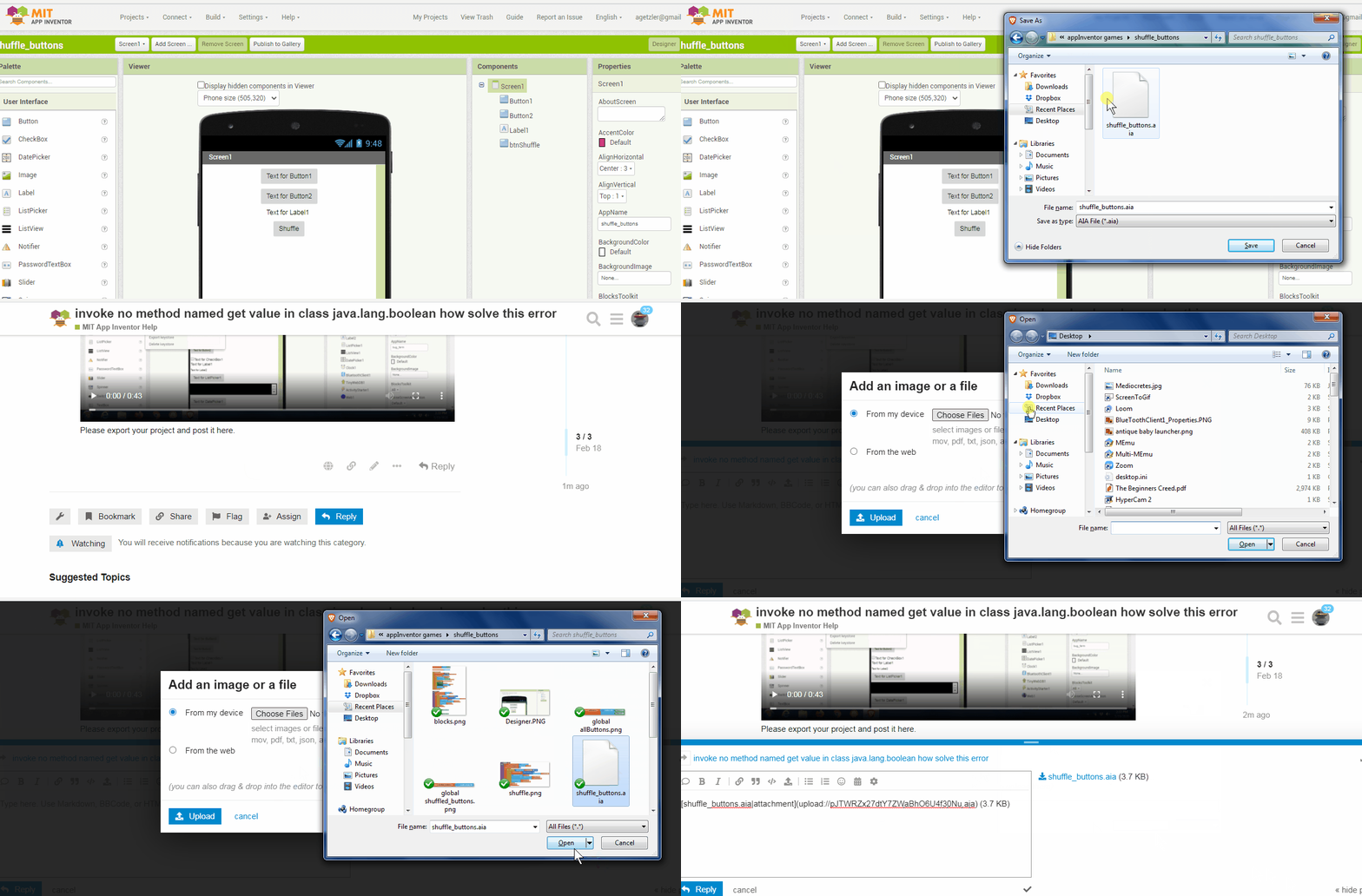
(Canned Reply: ABG- Export & Upload .aia)
Export your .aia file and upload it here.
.