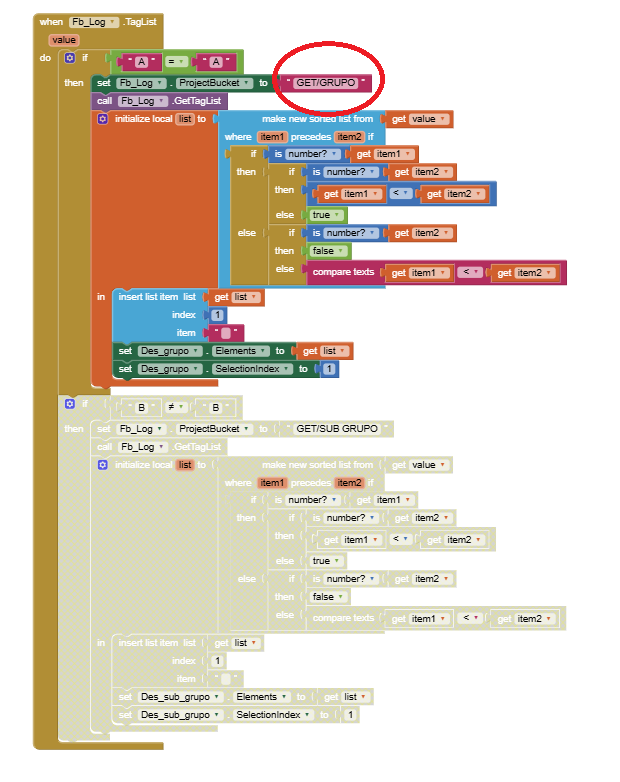
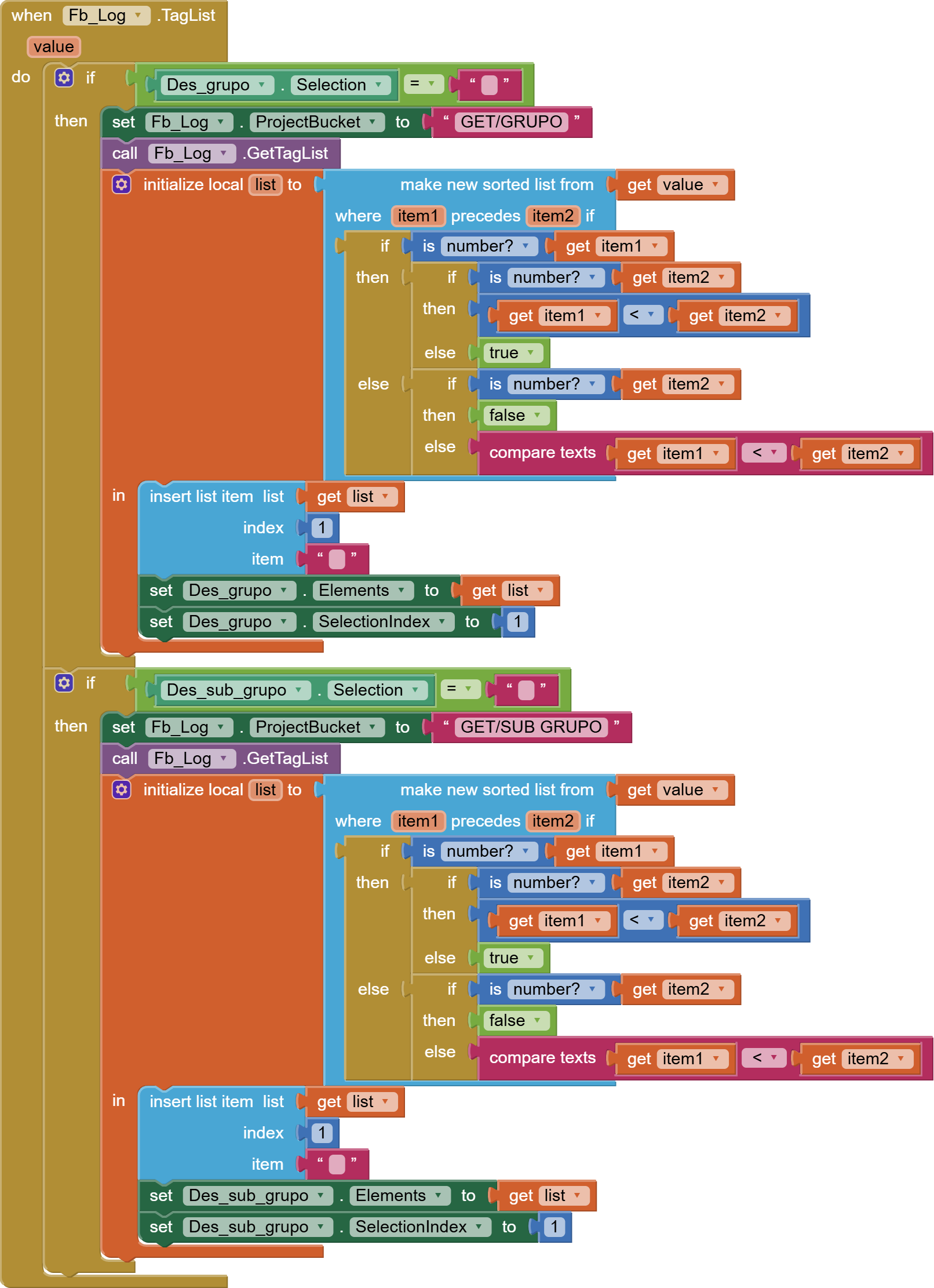
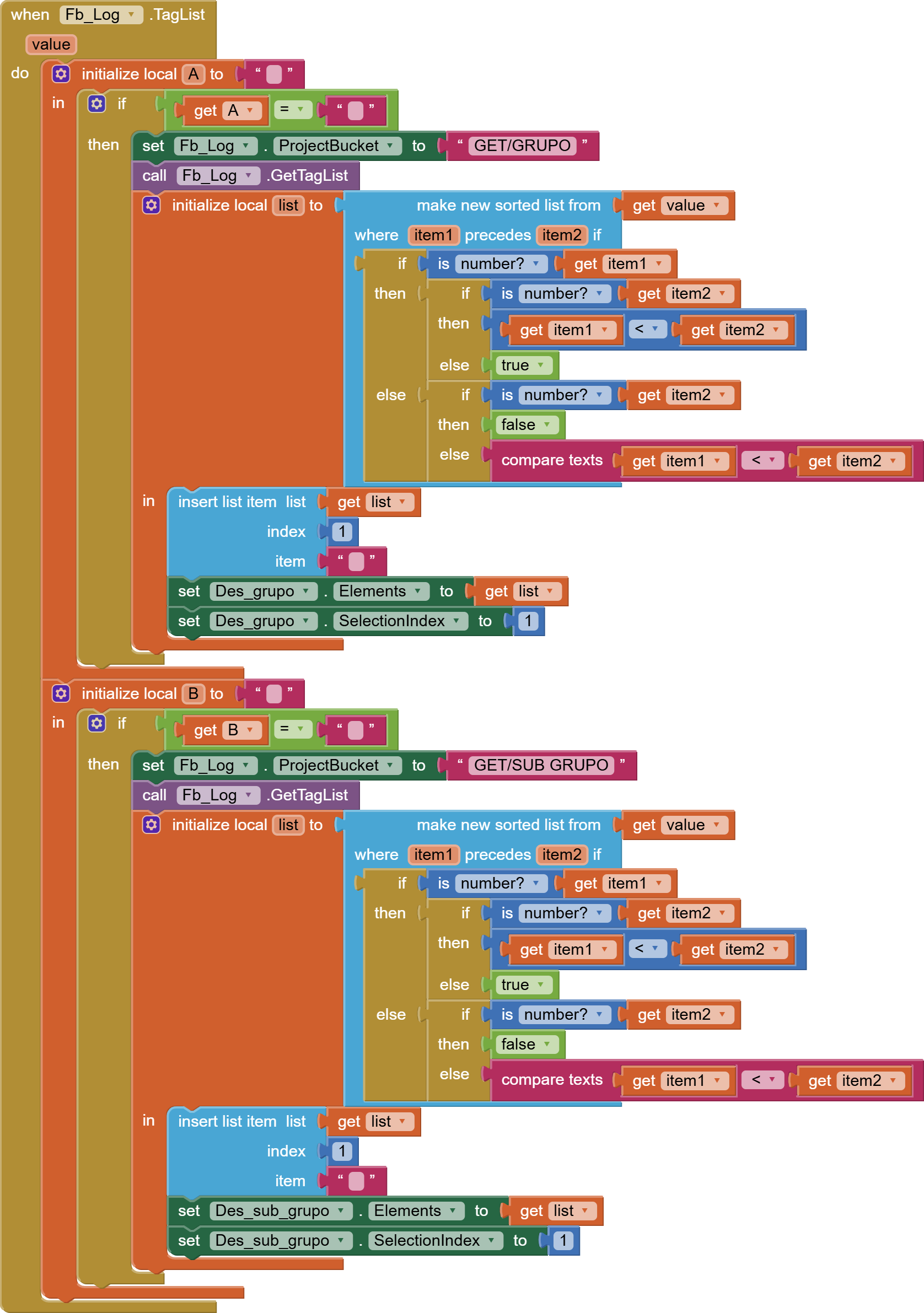
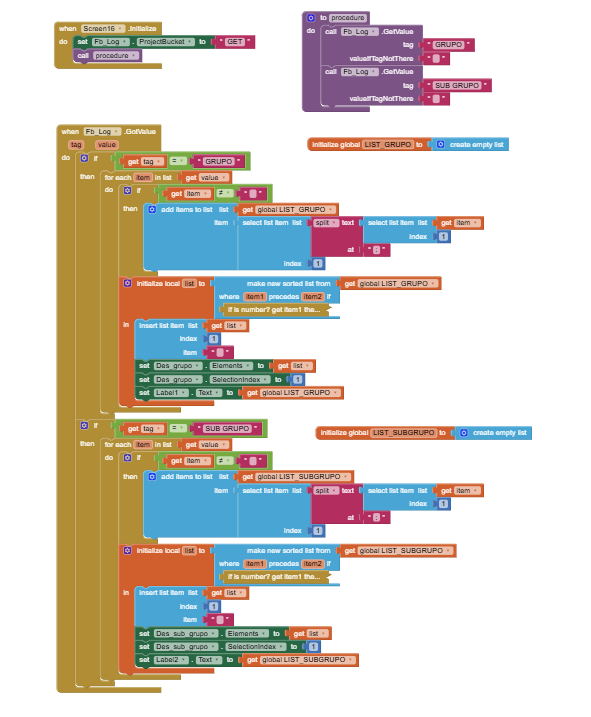
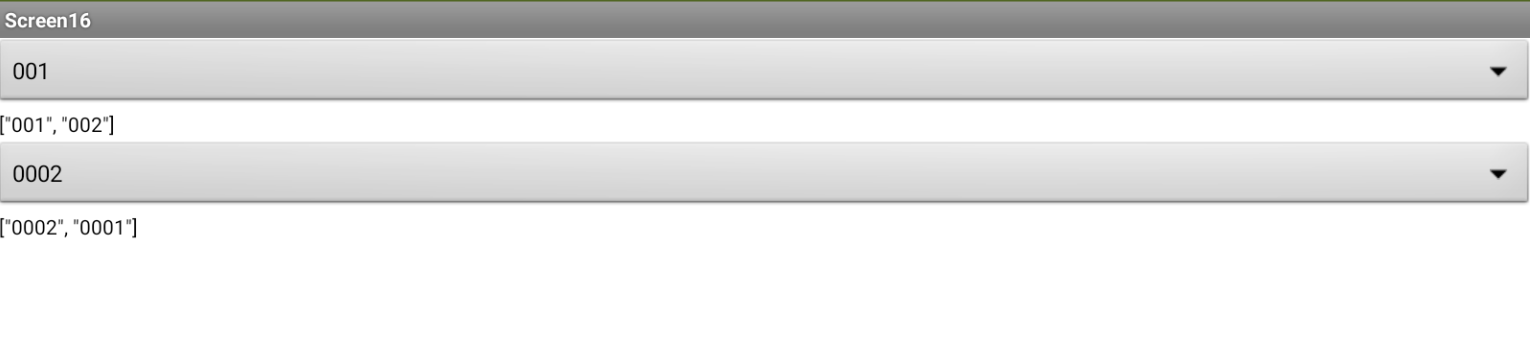
This time I'm trying to reduce my use of FirebaseDB.
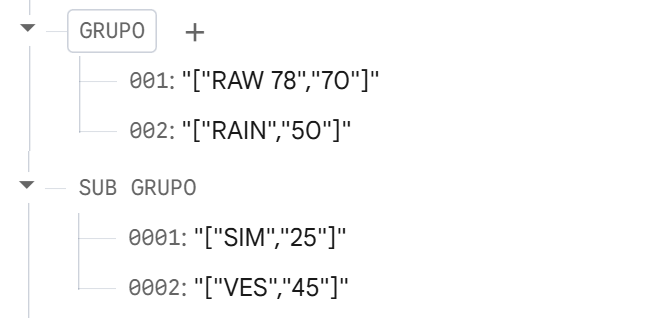
That's why I'm trying to get two lists of tags with the same name but different paths: GET/GROUP and GET/SUB GROUP.
By the way, they're already sorted alphabetically.
ANY SUGGESTIONS?
This time I'm trying to reduce my use of FirebaseDB.
That's why I'm trying to get two lists of tags with the same name but different paths: GET/GROUP and GET/SUB GROUP.
By the way, they're already sorted alphabetically.
ANY SUGGESTIONS?
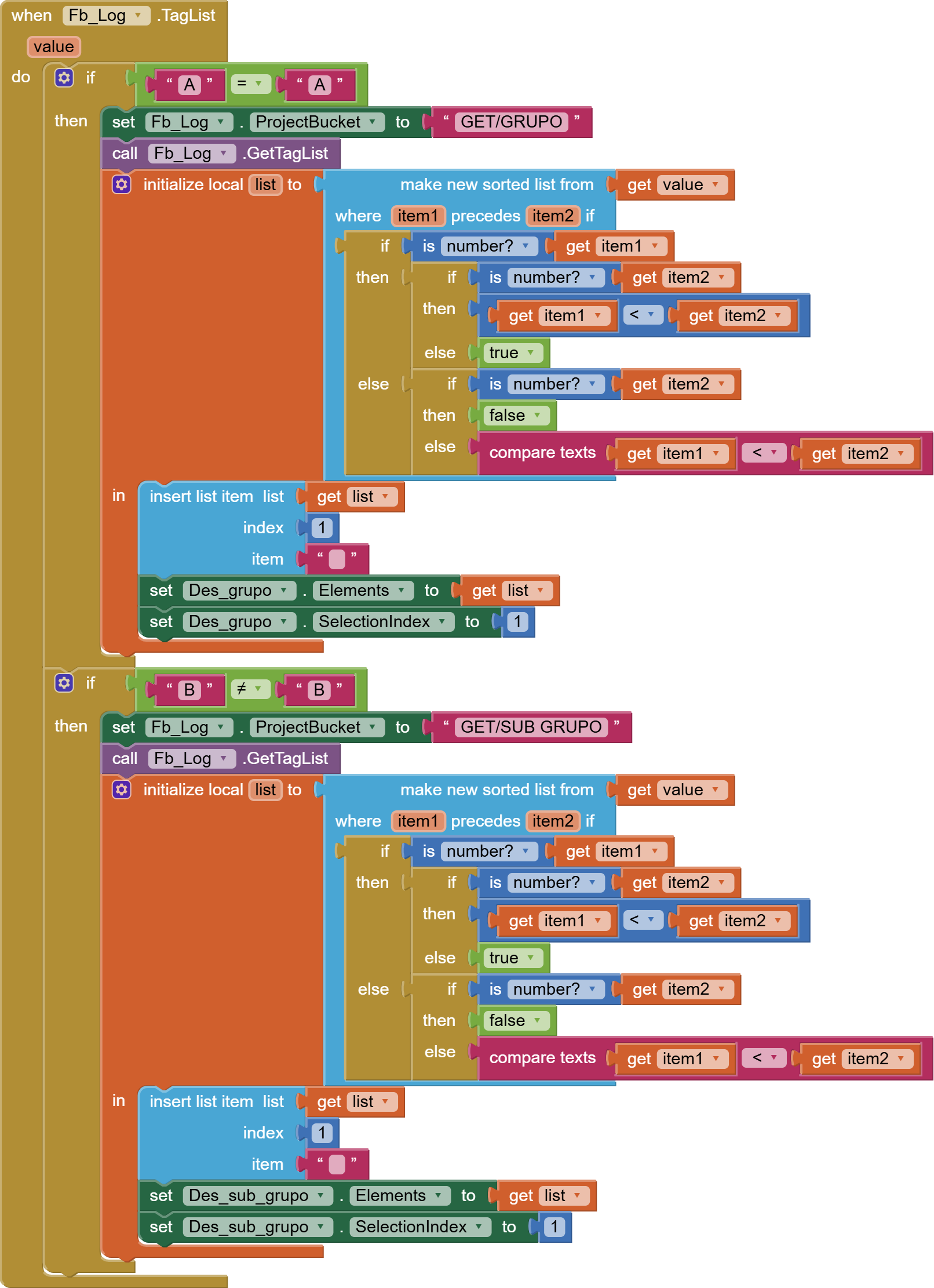
Your conditions make no sense at all: if A=A is always true. If B is not B = always false. Maybe you should learn how If (then,else or else-if) conditions work. Remember: If Conditions only return „true“ or „false“
Ps: 1. use „Do It“ to debug your blocks
2. Sorry, but I cant help here. Most of your blocks seem very confusing to me. Check your „if“ logic once more
Because of your data structure, you need to ask for everything under GET all in one request.
So set Bucket to GET and ask for the empty text as the tag..
When the tag/value arrives, you will receive nested dictionaries and lists, with everything you want buried in there somewhere.
Alternatively, you could set aside two global variables, one for each branch of the tree (GRUPO vs SUB GRUPO), both set to blank text when you submit two tag/value requests, one for GET/GRUPO and the other for GET/SUB GRUPO.
When tag/value request results arrive, you would have to save the value in the appropriate global variable, according to the incoming tag. After storing the value, check if either global variable is still empty. If one of them is empty, do nothing (leaving the processing for later, after both have arrived.) If both global variables are non-empty, you have enough data in them to pull whatever you want out of the global variables.
You are asking for a tag list.
Do you know the difference between asking for a tag list versus asking for the value at a specific tag?
of course
Yes, I've obtained several lists of values from a single FirebaseDB.
I've also obtained lists of labels, but only one list, not two as in the example.
Ask for the value of tag GET under bucket '' (the empty string.)
This will get you both lists, in a dictionary.
No matter how hard I try, I can't figure it out. I need a block diagram to understand it. 
Based on the data in the first post, what values would you want in which components?
Apparently, there are problems with leading zeros when using Dictionary.
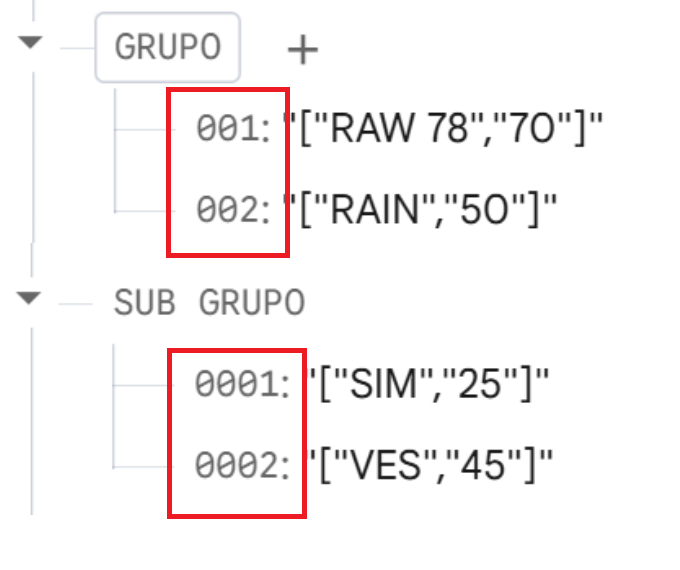
You want just what's in the red boxes?
That tells me you need to make those alphanumeric, so they will work in dictionaries.
How are you building up this data in Firebase?
yes
I add leading zeros so it doesn't exceed the limit.
The first list has 3 digits.
The second list has 4 digits.
But if it's necessary to change it, I can do so, but I need at least an example to guide me on how to obtain these two lists.
I am unable to data model this app, without knowledge of what each piece of data means, and how it relates to the data around it.
The labels are sequential numbers.
The values are initial equipment numbers and their weights
Why Grupo and Sub Grupo?
subgroup because they are lists that are within the group when you save them
each of those lists has its own items
This topic was automatically closed 7 days after the last reply. New replies are no longer allowed.