I have a multi-page app that is achieved by hiding/showing different screen arrangements.
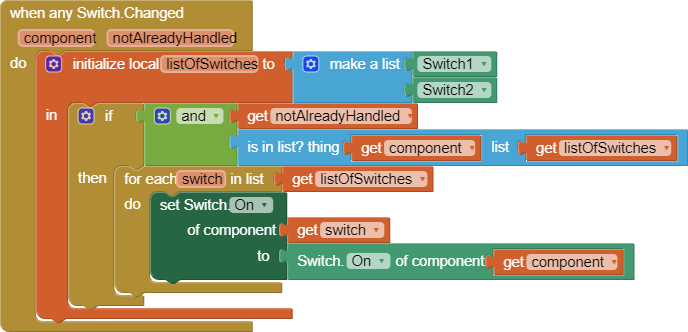
A couple of pages have settings switches that need to synchronise. i.e. if I switch one switch, the other also switches, and visa versa.
Can someone help me understand, conceptually, how I can synchronise these two swicthes without creating the extra flyback processing? I think using the ".Changed" function of the switch, the code will fly back one extra step unnecessarily eg:
Switch 1 on, switch 2 on.
Manually change switch 1 to off.
Through the ".Changed" function of switch 1, we programmatically turn switch 2 off, but becasue switch 2 turns off, this ".Changed" then prompts a return to switch 1, but seeing as switch 1 is already set to off there is no "Change" and the execution stops.
Is this third flyback necessary or is it really a non-problem?
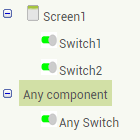
These blocks are generic blocks. You do not necessarily need to know what components they are setting/getting, and they are useful for loops like "for each item in list". You can find more in the documentation.