How about attacking stack depth?
Make a series of variables for your intermediate results, and pass intermediate results from variable to variable, to lower stack depth requirement.
How about attacking stack depth?
Make a series of variables for your intermediate results, and pass intermediate results from variable to variable, to lower stack depth requirement.
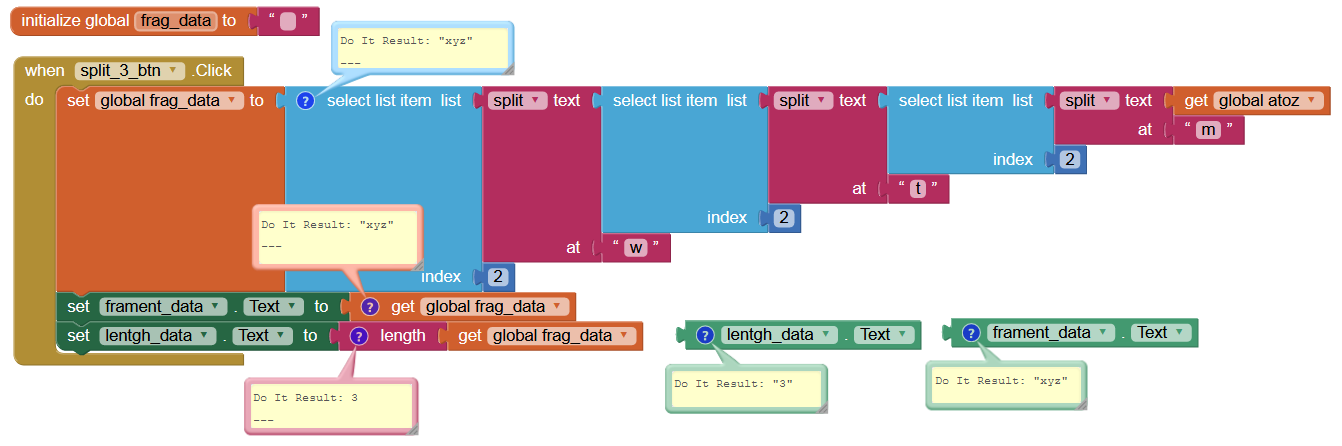
Anke – Right Click/Do It for the “Select List” block returns “xyz”, for the “fragment_data” block returns “”. Hmmmm
Maybe you’re failing to apply Do It to the set label.Text To block?
I'm starting to think you're kidding us. 
Do you have screen session recording software like Loom (free) to show us the sequence of operations?
OK, when I “right-click-and-Do-It” on the split_3_btn “Set fragment_data” green block (ABG’s “do it first”), I see no resulting comment in the Blocks Editor but the correct result (xyz) appears on my tablet! Same thing for the “Set length_data” block (no comment but correct display on tablet). An analogous action on the other two buttons’ blocks has the same effect of putting the correct answer on the tablet. So what still DOESN’T work is eliciting the correct data on the tablet by pressing the actual “Three Split” button!? I’ve looked carefully and don’t see any difference on the Designer page between the three buttons. Does this help?
I tried adding another fresh button and copying the blocks for the third split to the new button – still didn’t work.
Browser ? - should be Chrome or Firefox (clutching at straws now…)
Here’s something to investigate …
Is there a time delay between assigning the fragment_data.Text value in the button Click, and the availability of the fragment_data.Text value in the following statement?
That problem would not manifest if steps were done manually.
(edit - I wonder if such behavior were a side effect of some kind of ‘optimization’ at the O/S level?)
(edit #2 - To test this hypothesis, add a local variable as the output of the long split sequence, then assign that into the fragment.Text and then assign the length of the temporary variable to the other output .Text field. This would avoid reverse flow from the GUI during an Event.)
TIMAI2 – I’m using Chrome.
ABG – I don’t understand what you’re suggesting.
Good ideas, but no luck. Button 3 still doesn’t work. “Do It” on the local “temp” variable generates an “Unbound Variables” pop-up that wants me to enter a value!? However, although “Do It” on the “Initialize local temp” block fails to generate any responsive comment, the correct results now appear on the tablet display – both xyz and 3 (kinda like what we’ve seen before).
Thanks Anke, but nope. As before, except now the “Do It” tickle doesn’t even produced the correct result on the display like it did previously.
Clearly there is a mystery here and things I don’t understand, but you’ve cleared up my initial question. I’m assuming from your responses and suggestions that my original program and your subsequent modification all SHOULD have worked (and indeed, they do in your hands). This issue would therefore appear to be a function of my devices – laptop, wifi, and/or tablet – and I will admit that they are all somewhat old and out-of-date. Rather than consuming any more of your time, I suggest we move on and file this under “Things that make you go Hmmm”. I truly appreciate the time and effort you all extended to help me with this.